SEO for Law Firms: Why Most Attorney Websites Fail to Rank

SEO for Law Firms: Why Most Attorney Websites Fail to Rank

seo-for-law-firms

Something doesn’t add up.


Your law firm has a website. You’ve spent real money on it. A professional designer. A decent copywriter. Maybe even a homepage video. It looks good. It reads well.

And yet when someone types ‘personal injury attorney near me’ or ‘family lawyer in [your city]’ you’re nowhere to be found.

A smaller firm with a plainer website sits in the top three results. They’re fielding calls from exactly the clients you want.

This is not random. There are specific, fixable reasons why most attorney websites fail to rank on Google. Almost none of them have anything to do with how good you are at law.

We’ve audited hundreds of law firm websites. The same problems show up again and again. Here’s what’s actually going wrong and what to do instead.

First, what’s actually at stake here?


Legal is one of the most valuable niches in local search. A single new client can be worth thousands of dollars in fees. Sometimes tens of thousands. Being invisible on Google isn’t just a marketing problem. It’s a revenue problem.

Here’s what the data shows about how people find legal help:

  • Over 96% of people seeking legal advice start their search online
  • 75% never scroll past the first page of Google results
  • The top 3 local results the Map Pack capture over 40% of all local clicks
  • Someone searching ‘attorney near me’ is ready to call. That is high-intent traffic.

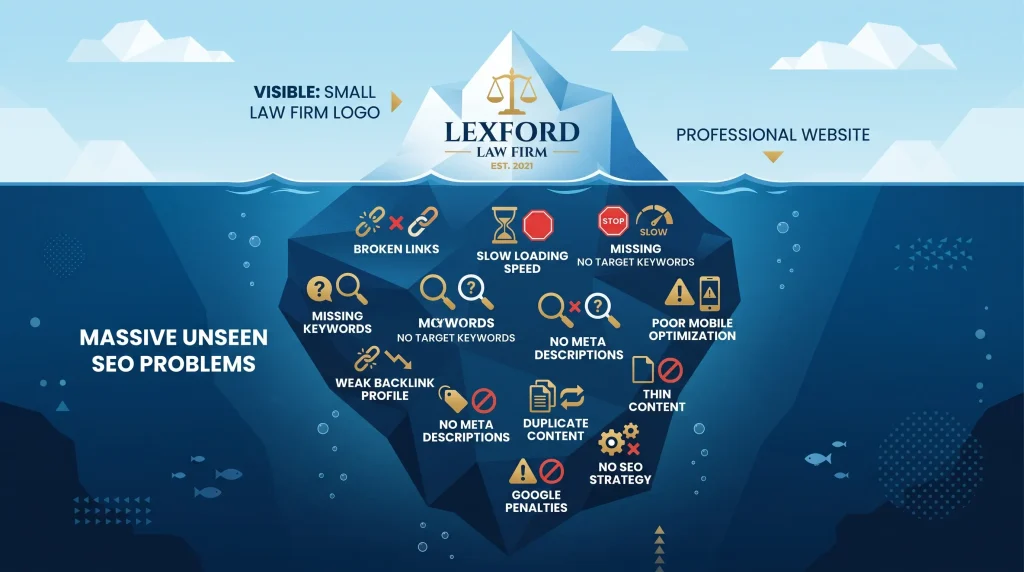
Most law firm websites are invisible to these searches. Not because the firm is bad at law. Because the website is set up in ways Google can’t read, doesn’t trust, or doesn’t rank.

Let’s get into the specifics.

8 Reasons Attorney Websites Fail to Rank And How to Fix Them

attorney-websites-performance


01  The site tries to rank for everything and ranks for nothing

This is the most common structural mistake we see. A firm handles personal injury, family law, criminal defence, and estate planning. So the website tries to cover all of it.

The homepage mentions ‘comprehensive legal services.’ Practice area pages run 300 words each. It’s thin. It’s vague. And Google doesn’t reward it.

Google rewards depth not breadth. When someone types ‘divorce lawyer in Chicago,’ Google wants a page that covers divorce law in Chicago thoroughly. Not a page that mentions it alongside four other practice areas.

THE REALITY

Shallow websites signal to Google that no single page is the authority on any topic. So none of them rank well for anything.

02  The homepage headline says ‘experienced’ and nothing else


Open ten law firm websites right now. At least seven will have a headline like ‘Experienced. Dedicated. Trusted.’ Or: ‘Fighting for Your Rights Since 1998.’

A suited partner in front of a bookcase. A button that says ‘Schedule a Consultation.’

The problem isn’t that it looks bad. The problem is it tells Google almost nothing useful.

Google’s algorithms understand what a page is about. They judge whether it answers a specific search better than competing pages. A homepage full of adjectives gives Google nothing to work with.

It also fails the real person reading it. Someone who’s just been in a car accident doesn’t respond to ‘Experienced. Dedicated. Trusted.’ They respond to: ‘We help New York car accident victims get fair compensation and we don’t get paid unless you do.’

THE REALITY

Generic headlines don’t help Google understand who you serve. They also don’t connect with the stressed person who actually needs you right now.


THE FIX

Lead with specificity. Name your practice area, your city, and the problem you solve in the first sentence. ‘Personal injury law firm in [City] helping accident victims win fair compensation since 2005’ beats ‘Experienced Legal Representation’ every time.

03  There is no local SEO presence beyond the website

A website alone is not enough to rank locally. Google uses many signals to decide who appears in local results. A well-coded website is just one of them.

The firms dominating local search have built an entire ecosystem. Most firms we audit are missing most of it.

THE REALITY

A website with no Google Business Profile, no citations, no reviews, and no local backlinks is invisible outside its own domain. Google doesn’t know you exist.

What top-ranking law firms have in place:

  • A fully optimised Google Business Profile correct categories, services, photos, and weekly posts
  • Consistent NAP details across every directory: Avvo, Justia, FindLaw, Martindale, Yelp, local chambers
  • Active Google reviews with a firm response to every single one
  • Backlinks from local news, bar association pages, sponsorships, and community organisations
  • Location-specific pages on the website not just a city mentioned in the footer

The Google Business Profile gap is especially costly. We’ve seen 15-year-old firms rank below brand-new competitors. Why? The newcomer had an active, optimised GBP. The established firm’s profile was basically empty.

04  The site has descriptions not real content


There’s a big difference between a page description and actual content. Most law firm pages are descriptions.

A description says: ‘Our personal injury attorneys have decades of experience. Contact us for a free consultation.’

Real content says: ‘If you were in a car accident in New York and the other driver was at fault, you may be entitled to compensation for medical bills, lost wages, and pain and suffering. Here’s what the claims process looks like. Here’s what to avoid. Here’s why legal representation typically leads to higher settlements.’

The second version is useful. It answers real questions. It shows knowledge. It keeps someone on the page. And it’s exactly what Google wants to surface to people searching for answers.

THE REALITY

Google’s Helpful Content system penalises pages that exist for search engines rather than people. If your content was written to rank rather than to help it’s being pushed down.


THE FIX

Write every practice area page as if a scared potential client is reading it at 11pm. Answer their real questions. Walk through the process. Address their fears. That’s the content that ranks and converts.

05  The firm’s expertise is invisible to Google


This one frustrates established attorneys most. The expertise is real. It’s just not visible online.

Google uses E-E-A-T Experience, Expertise, Authoritativeness, Trustworthiness to evaluate legal content. Legal falls under YMYL: Your Money or Your Life. Bad legal information causes real harm. So Google is sceptical. It needs proof.

The expertise needs to be shown not just claimed. And it needs to be verifiable.

THE REALITY

Twenty years of legal expertise locked inside your head is invisible to Google. What matters is what’s written, linked, and verifiable on the web.

06  The website has technical problems nobody noticed


Strong content and a solid local presence can still be undone by technical problems. These issues are invisible to the human eye. But Google sees them clearly.

Law firm websites are especially prone to this. Most firms build a site once and leave it. Years pass. Google’s standards evolve. Things break quietly.

THE REALITY

Slow load times, broken links, poor mobile experience, and pages blocked from indexing all suppress rankings regardless of how good the content is.


THE FIX

Run a technical SEO audit before assuming your problem is content or competition. Tools like Screaming Frog, Ahrefs Site Audit, or Google Search Console surface most issues quickly. A technical audit typically takes 2-3 hours and is often the fastest path to ranking gains.

07  Nobody is building links to the site


This one needs ongoing effort. That’s why most firms avoid it. But it can’t be skipped.

Google uses external links as authority signals. A link from your local bar association’s website is a third-party endorsement. A link from a local news article quoting you as a legal expert carries real weight.

A site with no external links starts every search at a disadvantage no matter how good the content is.

Law firms often assume reputation builds links naturally. It doesn’t. Links have to be earned.

THE REALITY

A newer competitor with a weaker track record can outrank an established firm just by having more quality backlinks. Reputation doesn’t automatically become SEO authority.

08  The firm has never asked a client to leave a Google review


This is the simplest fix on the list. And the one most firms have never done systematically.

Google reviews are a confirmed local ranking factor. They affect whether you appear in the Map Pack. They affect how often people click your listing.

A firm with 2 reviews and a 4.0 average loses clicks to a competitor with 47 reviews and a 4.8 even if the first firm is objectively better at law.

Most law firms have no review process. They rely on the occasional client who thinks to leave one. That’s a losing strategy.

THE REALITY

One bad experience generates a review far more reliably than ten great ones. Without asking satisfied clients, your review profile will always skew negative.


THE FIX

Make review requests part of your case closure process. When a matter ends well, send a short email or text: ‘If you’re willing, a Google review would mean a lot to us and helps others in similar situations find us.’ Automate it. Send it every time. It compounds.

So where do you start?


Don’t try to fix everything at once. That’s a recipe for fixing nothing. Here’s the order that moves rankings fastest:


Priority

Action

Time to see results

1

Fully optimise your Google Business Profile

2–8 weeks

2

Fix technical issues speed, mobile, indexing, schema

4–12 weeks

3

Start your review acquisition process

8–16 weeks

4

Rebuild practice area pages with deep, useful content

3–6 months

5

Build citations and earn backlinks consistently

4–9 months

A word on competition because legal SEO is tough.

Legal is one of the most competitive verticals in local search. Your competitors are spending real money on SEO. Some top-ranking law firm sites have been building authority for over 10 years. Getting from page three to the top three takes time.

But here’s the flip side. Most law firms are doing the basics poorly. There’s real room to move for firms willing to be thorough and consistent.

We’ve helped law firms in mid-sized markets go from zero local presence to the top three Map Pack results in six months. No tricks. Just getting the fundamentals right.

The firms that win local legal search aren’t the ones with the biggest budgets. They’re the ones with a complete ecosystem: a fast website, an active GBP, steady reviews, useful content, and a growing backlink profile.

All of that is achievable. It just takes a plan and some patience.

Why E-E-A-T matters more for law firms than almost anyone


Google built E-E-A-T Experience, Expertise, Authoritativeness, Trustworthiness because some search topics carry real-world consequences. Legal is at the top of that list.

Wrong legal information causes genuine harm. So Google applies extra scrutiny before ranking any legal page. The more trust signals your firm carries online, the more Google rewards you.

Experience

Years practised. Case types handled. Real outcomes. Not claimed shown through content, testimonials, and case studies.

Expertise

Bar admissions. Specialist certifications. Published articles. Speaking engagements. Every attorney needs a detailed bio page.

Authority

Bar association listings. Avvo profiles. Martindale ratings. Press mentions. Local directory citations. Third-party proof of your credibility.

Trust

Transparent pricing or process. Responsive review management. Clear privacy policy. Secure HTTPS site. No misleading claims.

The bottom line.

Most attorney websites fail to rank because they were built to look good not to work hard. They’re brochures. They tell people the firm exists. But they don’t give Google any reason to show them to people actively searching for legal help.

The firms dominating your local results aren’t there because of tricks or shortcuts. They did the unglamorous work. Good content. Technical hygiene. Consistent reviews. Steady link building.

You can do the same. You just need to know what to fix first and stick with it long enough for Google to take notice.

We offer a free SEO audit for law practices. No obligation. No jargon. Just a clear look at what’s holding your site back and what to prioritise first.

Why Your Google Business Profile Is Hurting Your Dental Practice

Why Your Google Business Profile Is Hurting Your Dental Practice?

Let’s be honest for a second.

You didn’t go to dental school to become a digital marketing expert. You became a dentist to help people. But here’s the uncomfortable truth right now, someone in your city is typing ‘dentist near me’ into Google, and your practice isn’t showing up. A competitor is getting that appointment. Not because they’re better at dentistry. Because their Google Business Profile is better set up than yours.

That stings a little, doesn’t it?

The good news is this is completely fixable. And you don’t need to become an SEO nerd to do it. You just need to know what’s actually broken which is exactly what this article is about.

We’ve audited hundreds of dental practice profiles over the years. The same mistakes show up again and again. Practices losing new patients every single week because of things that take 20 minutes to fix. So let’s get into it.

First what exactly is a Google Business Profile?

Your Google Business Profile (GBP) is the listing that shows up when someone searches for your practice or searches for a dentist in your area. It’s that box on the right side of Google search results, and it’s what populates the map when people search ‘dentist near me.’

Getting into that map section what SEOs call the Map Pack is everything in local search. It sits above the regular search results. It gets the clicks. It gets the calls. And your GBP is the main thing Google looks at to decide whether you deserve to be there.

Google judges your listing on three things:

  • Relevance does your profile match what the person is searching for?
  • Distance how close are you to the searcher?
  • Prominence does Google trust you? Are you active? Do people review you?

You can’t control distance. But relevance and prominence? Those are entirely in your hands. And most dental practices are leaving both on the table.

Google Maps 002

9 Things Your Google Business Profile Is Getting Wrong

#1 — You’ve only selected ‘Dentist’ as your category

This is the most common one we see. Someone set up the profile a few years ago, picked ‘Dentist,’ and moved on. Completely understandable. But it’s costing you.

Your primary category tells Google what you are at your core. Your secondary categories tell Google everything else you do. If a parent types ‘children’s dentist’ near you and you haven’t added Pediatric Dentist as a secondary category, you simply won’t appear even if you see kids every day.

WHY IT HURTS

Google treats categories as a primary ranking signal. A dentist who only lists ‘Dentist’ competes for one type of search. A dentist who adds five relevant categories competes for five.

What to do: Go into your GBP dashboard and add every category that genuinely reflects your services. Don’t add things you don’t offer Google can spot that and it can backfire. But if you do it, claim it.

  • Cosmetic Dentist
  • Dental Implants Periodontist
  • Orthodontist
  • Pediatric Dentist
  • Emergency Dental Service

#2 — Your name, address, or phone number is inconsistent across the web

This one is invisible to most practice owners, which is exactly why it does so much damage.

Google doesn’t just look at your GBP in isolation. It cross-checks your practice details against dozens of other websites Yelp, Healthgrades, Zocdoc, local directories, your own website. When those details don’t match, Google gets nervous. A confused Google is a Google that stops trusting you.

We’ve seen practices lose significant ranking ground because their old address was still listed on three directories, or because their practice name had a spelling variation on Yelp. Tiny things with real consequences.

WHY IT HURTS

Inconsistent NAP (Name, Address, Phone) signals across the web create what’s called a ‘citation conflict.’ Google resolves uncertainty by ranking you lower, not higher.

THE FIX

Run a citation audit. Tools like BrightLocal or Whitespark will pull every place your practice is mentioned online. Go through the list and make your NAP identical everywhere — same abbreviations, same suite format, same phone number. It’s tedious but very much worth the effort.

#3 — Your Services section is empty or barely filled in

Here’s something most dentists don’t know: Google actually reads your Services section to figure out what you do. It’s not just a nice-to-have for patients browsing your profile. It’s a searchable part of your listing.

When someone searches ‘teeth whitening near me’ or ‘Invisalign consultation [city],’ Google checks GBP services sections. If yours is blank, you’re invisible to that search. Full stop.

WHY IT HURTS

An empty services section means Google has less signal about what you offer, which means you rank for fewer searches. Simple as that.

Fill in every service you genuinely offer. Write a real 2-3 sentence description for each one not just the service name. Think about what a nervous patient would want to know before calling. Include things like:

  • Routine check-ups and hygiene appointments
  • Teeth whitening (in-chair and take-home options)
  • Dental implants
  • Invisalign and clear aligner treatment
  • Root canal treatment
  • Composite bonding and veneers
  • Emergency appointments
  • Children’s dentistry

#4 — You haven’t posted anything in months or ever

Google Posts are short updates that appear directly on your GBP listing, right there in the search results. Think of them like Instagram posts, but for Google. When a patient searches for you and sees a recent post from two days ago, it signals that your practice is active and worth trusting.

When Google sees that you haven’t posted since last March? That’s a different signal entirely.

WHY IT HURTS

Inactive profiles get deprioritised. Google’s prominence score favours businesses that are alive and engaged. Dormant profiles slide down the rankings slowly but consistently.

You don’t need to post essays. Short and useful beats long and occasional. Aim for one post a week. Some easy ideas:

  • A quick tip (‘Sensitive teeth this winter? Here’s why it happens and what we can do’)
  • A service spotlight (‘We’re now doing same-day crowns — no second appointment needed’)
  • A team moment (‘Brilliant turnout at our open day last Saturday — thank you!’)
  • A seasonal offer (‘Free consultation on composite bonding throughout January’)

Each post should end with a clear call to action. Book online. Call us. Learn more. Don’t make people guess what to do next.

#5 — You’re not responding to reviews especially the bad ones

This one is personal, and we understand why it gets avoided. A harsh review from a patient who genuinely had a difficult experience feels unfair. But leaving it unanswered is quietly killing your new patient conversion rate.

More than 70% of people read reviews before choosing a healthcare provider. And here’s what they’re actually looking for they want to see how you handle things when something goes wrong. A thoughtful, professional response to a critical review tells new patients far more about your character than a collection of five-star reviews alone.

From a pure SEO standpoint, review signals quantity, recency, sentiment, and whether you respond are confirmed local ranking factors. Unresponded profiles rank lower than active ones.

WHY IT HURTS

Google’s E-E-A-T guidelines (Experience, Expertise, Authoritativeness, Trustworthiness) treat dental practices as YMYL — Your Money or Your Life content. Trustworthiness is everything, and review engagement is one of the clearest trust signals you can send.

The approach that works:

  • Respond to every review within 48 hours, positive or negative
  • For positive reviews: be specific, not generic. ‘Thank you for your kind words!’ lands flat. ‘Really pleased the whitening treatment gave you the result you were hoping for’ feels human.
  • For negative reviews: acknowledge it, stay calm, and invite them to call you directly. Never share clinical details. Never get defensive. Keep it brief and kind.

EXAMPLE

Response to a 2-star review: ‘Thank you for taking the time to share this we’re sorry your experience wasn’t what you expected. Please do give us a call directly so we can have a proper conversation about it. We’d genuinely like the opportunity to make things right.’

#6 — Your photos are poor, old, or missing entirely

Dental anxiety is real. A huge number of people put off dental appointments precisely because the thought of walking into an unfamiliar clinical environment makes them uncomfortable. Photos on your GBP can actually help fix that.

When a nervous patient sees your bright, welcoming reception area, your friendly-looking team, your clean and modern surgery before they’ve even made an appointment you’ve already started building trust. Profiles with photos get considerably more clicks and direction requests than profiles without.

WHY IT HURTS

Photo engagement is a prominence signal. A listing with 20 high-quality photos outperforms an identical listing with 3 blurry ones, all else being equal.

The photos worth having:

  • Outside your building help people recognise where they’re going
  • Your reception or waiting area warm it up, it matters
  • Treatment rooms clean, modern, non-intimidating
  • Your team people want to see who’s going to treat them
  • Your equipment modern tech signals quality care
  • Before/after results with written patient consent, these convert browsers into bookers

Hire a photographer for half a day once a year. The return on that investment, in new patient bookings, is significant. Update your photos quarterly if you can.

#7 — Your hours are wrong, outdated, or missing for bank holidays

This one seems obvious but we still catch it regularly. The practice has moved to slightly different hours, or a dentist left and Saturdays are no longer open, but the GBP still shows the old times.

What happens next is painful. Someone calls during what Google says are your opening hours. Nobody picks up. They assume you’re closed, disorganised, or not taking new patients. They call the next practice on the list. You’ve lost them forever.

Bank holidays are an especially common gap. Patients plan ahead. If someone is checking whether you’re open on Good Friday and your GBP doesn’t have special hours set, Google defaults to showing your regular hours and that patient shows up to a closed door.

WHY IT HURTS

Inaccurate hours erode trust quickly. Google also picks up on user behaviour signals — if people regularly find that your listed hours are wrong, your profile takes a hit.

THE FIX

Set your regular hours correctly and stay on top of them. Add special hours for every bank holiday at least a few weeks in advance. If you offer late-night or weekend slots, make sure those show up — they’re often the thing that closes a new patient inquiry.

#8 — Your business description sounds like it was written by a robot

We’ve read thousands of GBP descriptions at this point. The pattern is depressingly familiar: ‘We are a leading dental practice committed to providing high-quality dental care in a welcoming environment. Our experienced team of dental professionals…’ and so on.

Nobody reads that. Nobody feels reassured by it. And Google certainly doesn’t reward it.

Your description (up to 750 characters) is one of the few places on your GBP where you can speak directly to a prospective patient. Use it like a real person would. Tell them what makes your practice different. Tell them who you’re especially good for. Make them feel something.

WHY IT HURTS

A vague, generic description misses two opportunities at once: telling Google what you do and where, and convincing an anxious patient that you’re the right fit for them.

A description that actually works has:

  • Your location mentioned specifically (neighbourhood, city, nearby landmark)
  • Your standout services the things you’re genuinely known for
  • Something human your approach, your team’s experience, what patients say about you
  • A natural call to action nothing salesy, just an invitation

EXAMPLE

We’ve been looking after patients in [City] for over [X] years — nervous patients especially. At [Practice Name], we do everything from regular check-ups and teeth whitening to dental implants and Invisalign, all from our clinic on [Street]. Same-day emergency appointments are usually available. If you’ve been putting off the dentist, we’d love to change that.

#9 — You’ve never touched the Q&A section

The Q&A section sits on your GBP listing and is entirely open to the public. That means anyone can ask a question about your practice and anyone can answer it. Including your competitors. Including people who have never visited you.

Most practices don’t even know this section exists until someone asks a leading question and a stranger answers it with something inaccurate. By that point, hundreds of prospective patients may have seen it.

WHY IT HURTS

An unmanaged Q&A section is a live risk. It’s also a missed opportunity questions and answers are indexed by Google and can help you appear in voice searches and featured snippets.

Take 30 minutes this week and do two things:

  • Check if anyone has already asked questions and answer them properly
  • Add your own frequently asked questions and answer them yourself

Good questions to pre-populate:

  • Are you accepting new patients? (Answer: Yes you can book online or call us on [number])
  • Do you offer emergency appointments? (Answer: Yes, we keep slots available each day for urgent cases)
  • Do you treat nervous patients? (Answer: Absolutely this is something we take seriously)
  • Is parking available? (Answer: Yes, there’s free parking directly outside)
  • Do you offer payment plans? (Answer: Yes, we work with [finance provider] for 0% options)

Your quick GBP audit - run through this today

Bookmark this checklist. Go through it this week. Most of these take under 30 minutes to fix:

What to check

What good looks like

Business categories

1 primary + 3 or more secondary categories

Practice name, address, phone

Identical across GBP, website, and every directory

Services section

Every treatment listed with a proper description

Photos

10+ photos, refreshed within the last 3 months

Google Posts

Something published in the last 7 days

Review responses

Every review positive and negative replied to

Business hours

Correct regular hours plus upcoming bank holidays

Business description

Specific, warm, keyword-aware, over 600 characters

Q&A section

At least 5 questions pre-answered by you

Website link

Points to a fast, mobile-friendly, HTTPS-secured site

A note on Google E-E-A-T and why it matters for dental practices specifically

dental 004

Google has a category of search topics it treats with extra scrutiny. They call it YMYL Your Money or Your Life. Health decisions, including choosing a dentist, fall squarely into this category.

What that means in practice: Google applies a higher trust threshold before ranking dental websites and GBP profiles. It’s looking for real signals of credibility, not just keyword matches. The framework it uses is called E-E-A-T:

Experience

Years in practice, real patient outcomes, before/after cases, authentic reviews not stock photos and generic claims.

Expertise

Qualifications, GDC registration, post-graduate training, specialist credentials. Listed clearly, not buried.

Authoritativeness

Links and mentions from dental associations, local news, health directories, patient review platforms. Volume of quality reviews.

Trustworthiness

Consistent information everywhere. Prompt review responses. Clear privacy policies. Secure website (HTTPS). No red flags.

So where do you start?

Pick one thing from the list above. Just one. The category issue if you’ve never touched it. The services section if it’s blank. Respond to those two reviews you’ve been putting off.

None of this requires an agency. None of it requires technical knowledge. It requires a couple of hours and some attention. The practices that consistently outrank their competitors in local search aren’t necessarily better at dentistry they’re just better at keeping their digital front door in good shape.

If you want a proper audit of your current GBP a specific list of what’s working, what’s broken, and exactly what to fix first we do those for free. No obligation, no sales pitch. Just a clear picture of where you stand.

Mastering Local SEO in Staten Island: The 2026 Growth Blueprint

Introduction: Why “The Forgotten Borough” is the New Digital Frontier

For years, Staten Island businesses relied on community reputation and word-of-mouth. However, in 2026, the digital landscape has shifted. With the rise of Agentic AI and “near me” queries dominating mobile traffic, Local SEO in Staten Island is now the primary bridge between your storefront and the 475,000+ residents across the borough. To win, you can no longer just “target keywords”—you must dominate the local ecosystem.

The Semantic Core: Entities Over Keywords

SEO Staten Island

Search engines now prioritize Entities the relationships between people, places, and things. To rank in the “Borough of Parks,” your content must be a web of local relevance.

  • Geographic Hubs: Your strategy must fragment “Staten Island” into its granular parts: St. George, Tottenville, New Dorp, and Great Kills.
  • Structural Context: Referencing the Staten Island Ferry, the Verrazzano-Narrows Bridge, or Empire Outlets provides “Ground Truth” to AI models that you are a legitimate local player.
  • Hyper-Local Intent: Pivot from “SEO Staten Island” to long-tail, high-intent phrases like “SEO for law firms in 10314” or “Staten Island restaurant marketing on Hylan Blvd.”

Becoming the Local Go-To: Our 2026 Roadmap.

To dominate the SERPs (Search Engine Results Pages), your website must act as a comprehensive guide rather than a sales pitch. Follow this Topical Map:

  1. Technical Foundation: Optimizing for 2026 Core Web Vitals, specifically focusing on mobile-first indexing for ferry commuters.
  2. GBP Mastery: Moving beyond basics by using “Google Business Profile” video updates to highlight community involvement.
  3. Local Backlinks: Earning mentions from the Staten Island Advance or the Staten Island Chamber of Commerce.
  4. Neighborhood-Specific Trust: Tailoring content for the North Shore’s commercial revitalization versus the South Shore’s residential service needs (HVAC, Plumbing, Real Estate).
North Shore waterfront

The “Ferry Effect”: Mobile & Commuter SEO

Staten Island has the longest average commute in the US. This means your potential clients are searching on their phones while on the Ferry or SIM express buses.

  • Zero-Click Optimization: Provide enough value in your headers and FAQ Schema that AI models cite you as the definitive source without the user needing to click.
  • Page Speed & “Dead Zones”: If your site doesn’t load instantly before a commuter enters a cellular “dead zone” in the harbor, that lead is lost.
  • Click-to-Call & Schema: Ensure your phone number and address are wrapped in LocalBusiness and ProfessionalService JSON-LD schema.

Optimizing for “Agentic AI” & Multi-modal Search

Agentic AI

In 2026, residents are asking AI agents: “Book the best-rated SEO consultant near New Dorp for a Tuesday morning meeting.”

  • Conversational Data Seeds: Use natural language blocks. “If you’re looking to grow your Richmond County business, our St. George-based team handles everything from technical audits to local citations.”
  • Visual Entities: Search is now multi-modal. By embedding geotagged images and videos of recognizable landmarks (like the Urby complex or Snug Harbor), you signal “Locality” to AI vision models like Google Lens.

Visual Strategy & AI Image Prompts

Visuals decrease bounce rates and prove your local presence. Use these prompts to generate high-quality, relevant assets for the article.

Section Image Concept AI Image Generation Prompt
Hero Image Futuristic marketing hub in Staten Island. Photorealistic, wide-angle shot of a sleek, modern office interior with large glass windows overlooking the Verrazzano-Narrows Bridge at sunset. Holographic SEO data charts floating in the air. 8k resolution, cinematic lighting.
Mobile SEO Commuter using a phone on the Ferry. Hyper-realistic photo of a professional person speaking into a smartphone at the St. George Ferry Terminal. In the background, the iconic orange ferry is docking. Soft morning fog, cinematic depth of field.
AI Search A digital “Twin” of a local SI shop. Creative split-screen composition. Left side: A traditional Staten Island storefront on New Dorp Lane. Right side: The same shop represented as a digital 3D model with floating review stars and SEO metadata. Neon digital accents.
Data Trust Strategy map of the Island. A high-tech digital overlay on a 3D satellite map of Staten Island. Glowing data points connected across neighborhoods like Westerleigh, Annadale, and Great Kills. Professional, blueprint-blue aesthetic.

Conclusion: The “Straight Talk” Advantage

Staten Island is a ‘straight-talk’ market. High-flown marketing jargon fails here; utility and local proximity win. By combining Technical SEO with Hyper-local Authority, your agency doesn’t just show up in search results it becomes a part of the borough’s digital infrastructure.