
A website can rank well and still leave the sales team with an empty inbox. The usual cause is simple: the pages attract people who are curious about a topic, not people who need what the business sells. Learning how to find keywords that attract qualified leads online starts with a different question. Instead of asking how many people search a term, ask who is searching it and whether you can help them.
In short, start with the problems your ideal customers want to solve. Research how they search for solutions and check the intent behind each query. Then score every candidate on relevance, ranking difficulty, and business value. Map the best ones to pages that fit, and measure qualified inquiries instead of traffic alone.
This guide walks through that process in ten steps. It includes a scoring framework you can rebuild in a spreadsheet and explains how to judge whether your keyword research for lead generation is working. Examples are samples unless noted. No real performance data is presented, and no keyword here is guaranteed to bring leads.
What Are Qualified-Lead Keywords?
A qualified-lead keyword is a search term that can connect a relevant searcher with a product, service, or solution your business offers. The word “qualified” describes the person, not the phrase. A lead is qualified when it meets criteria your business sets, such as service fit, location, budget, need, and buying authority. Those criteria vary by company, so define yours before you judge any keyword.
A keyword can signal an opportunity, but it cannot guarantee a qualified lead. Only your own data can show that. The table below contrasts a traffic-first approach with a lead-first approach.
| Question | Traffic-first thinking | Lead-first thinking |
| What matters most? | Search volume | Relevance to what you sell |
| Who is the visitor? | Anyone interested in the topic | A prospect who fits your service |
| How is success measured? | Visits and rankings | Qualified inquiries and sales opportunities |
| Main risk | Visitors who never contact you | Smaller audiences that need patient measurement |
This is why a broad keyword is not always a valuable one. A broad term can attract students, job seekers, competitors, and genuine buyers in one stream. A narrower term often says more about what the searcher needs, which makes it easier to tell whether you can help.
How to Find Keywords That Attract Qualified Leads
The ten steps below move from understanding your customers to discovering keywords, validating them, assigning them to pages, and measuring results.
1. Define Your Ideal Customer and Lead Criteria
Start with the business, not a keyword tool. Write down who you want to serve, what you sell, which markets or locations you cover, and what makes an inquiry worth pursuing. A short worksheet keeps this concrete. The sample below describes a B2B marketing business.
| Question | Example answer |
| Who is the ideal customer? | A B2B company that wants more qualified sales inquiries |
| What problem do they have? | The website attracts visitors but few relevant leads |
| What do you offer? | SEO strategy and conversion-focused content |
| What makes a lead qualified? | The company fits the target market and needs the service |
| What action do you want? | A consultation request |
Replace these answers with real customer profiles and sales records whenever you have them.
2. Identify Customer Problems and Buying Questions
Customers rarely describe their needs in industry jargon. Review sales call notes, consultation requests, support tickets, emails, and reviews. Write down the exact phrases people use, along with their objections and the outcomes they want. Then sort what you find into three groups:
- Problem-aware: the searcher knows something is wrong but not what fixes it (“why is my website traffic not converting”).
- Solution-aware: the searcher is looking for an approach (“keyword research for lead generation”).
- Purchase-oriented: the searcher wants help or a provider (“SEO agency for qualified leads”).
Public forums can add useful language, but check that their audience looks like your customers. Suppose a business owner says, “We get website visitors, but nobody contacts us.” That suggests phrases such as “why website traffic does not convert” or “how to get qualified leads from SEO.” Treat them as ideas to test, not proven demand.
3. Build a Seed Keyword List
Turn those needs into starting terms. Cover your services, the problems you solve, the outcomes customers want, and the audiences you serve. Keep the first list short. Dozens of near-duplicate phrases make evaluation harder, not better.
| Theme | Seed examples |
| Service | SEO services, keyword research |
| Problem | low-quality website leads, low organic conversions |
| Desired outcome | qualified leads from SEO, organic lead generation |
| Audience | SEO for B2B companies, SEO for small businesses |
| Commercial research | SEO agency for lead generation, keyword research services |
4. Expand Keywords Using Research Tools
Seed terms become a longer list when you run them through research tools. Each tool answers a different question:
- Google Keyword Planner suggests related keywords and shows estimated monthly searches and the cost to advertise on them. Google notes that you must finish Google Ads account setup, including billing information, to use basic features such as keyword ideas.
- Google Search Console shows the queries that already bring your own site impressions and clicks.
- Ahrefs and Semrush provide keyword variations, competitor rankings, and difficulty estimates.
- Google Trends compares relative interest over time.
- Autocomplete and related searches in Google add everyday phrasing.
AI assistants can help you brainstorm synonyms and questions. Their suggestions are not demand data, so check each phrase in a keyword tool before relying on it. Whatever you use, record the tool, the target country (the United States, for this audience), the settings, and the date. Keep estimates separate from the observed data in your own accounts.
5. Analyze Search Intent and Current Results
Search intent is the goal behind a query. People usually want to learn something (informational), reach a specific site (navigational), compare options (commercial investigation), or take action (transactional). The wording of a query offers clues, but the results confirm them.
Search the query in a US-based browser window and note what shows up: guides, comparison lists, service pages, product pages, or a mix. If the first page is dominated by service pages, a blog post is likely the wrong format for that keyword. If it is dominated by how-to guides, a sales page will probably miss what searchers expect. Repeat the check for a few representative queries in each keyword group, because intent can differ even between similar phrases.
6. Find Long-Tail and Commercial Keywords
Long-tail keywords are more specific queries, such as “SEO services for B2B lead generation” instead of “SEO.” Specificity often clarifies the searcher’s need. However, longer phrases do not always convert better, and they are not always easy to rank for. Test each one rather than assuming.
| Broad query | More specific query |
| SEO | SEO services for B2B lead generation |
| Website design | website redesign services for law firms |
| CRM software | CRM software for small sales teams |
These examples are illustrative. Check demand and intent before you target any of them. Modifiers such as services, agency, pricing, cost, best, alternatives, comparison, and “for small businesses” can hint that a searcher is evaluating options. They are signals, not proof. “Pricing,” for example, might come from a buyer or from a student writing a report. Confirm the meaning in the live results.
7. Research Competitor Keywords and Content Gaps
Your search competitors for a keyword are the pages that rank for it, not necessarily the biggest brands in your industry. Use a platform such as Ahrefs or Semrush to see which terms those pages rank for. Then compare their topics, page types, and examples with your own.
A real content gap is a meaningful reader question that the ranking pages answer poorly. A subtopic missing from one page is not automatically a gap. For each competing page, record the URL, the query, the page type, and the main intent. Note what it covers well, any gap, and how your content would respond. Use the findings to serve readers better, not to copy another page.
8. Evaluate Business Relevance and Ranking Feasibility
Now trim the list. For each candidate, ask three things. How closely does it relate to what you sell? Can you publish a credible, useful page for it? Can your site realistically compete with the pages that rank today? Keep paid and organic measures separate. Competition figures in Keyword Planner describe advertisers. Difficulty scores in third-party platforms estimate organic ranking competition. The next major section turns these questions into a repeatable score.
9. Map Keywords to the Right Pages
Give each page one primary intent. Group close variants on a single page when it can satisfy them naturally, and separate queries that need different formats. Avoid several pages for the same intent, because they compete with one another. Match the call to action to the visitor’s stage as well.
| Query group | Best page type | Likely next step |
| Why traffic does not convert | Educational blog post | Read a relevant guide |
| Keyword research for lead generation | Practical guide | Explore the research process |
| SEO services for B2B companies | Service page | Request a consultation |
| SEO agency pricing | Pricing or service information, if available | Evaluate fit and cost |
Check your existing site structure before you plan new pages. Different intentions usually need different content, which is where content marketing services can support production. A match on intent still has to be delivered. Google’s people-first content guidance asks whether a visitor will leave feeling they learned enough to reach their goal. A thin page fails that test, however well its keyword fits.
10. Measure Qualified Leads and Refine Your Strategy
Keyword selection is a hypothesis until results confirm it. Review Search Console for the queries and pages that earn visibility. Track conversions in your analytics. Record in your CRM which inquiries met your criteria. Revisit your list as the evidence builds, and feed what you learn back into your wider SEO strategy. The measurement section below covers the metrics in detail.
How to Identify High-Intent Keywords
High-intent keywords are searches that suggest the person is close to choosing a solution or a provider. Intent comes from the whole query and its context, not from a single word. The table shows how searches differ across the journey, using a sample SEO agency.
| Keyword type | Example | Likely purpose | Recommended page |
| Problem-aware | why is my website not generating leads | Understand a problem | Educational blog post |
| Solution-aware | SEO strategy for lead generation | Explore solutions | In-depth guide |
| Commercial investigation | best SEO agencies for lead generation | Evaluate providers | Comparison or service page |
| Transactional | hire an SEO agency for lead generation | Find a provider | Service or consultation page |
| Local commercial | SEO agency in New York | Find a nearby provider | Local service page |
| Product-specific | SEO lead tracking software | Evaluate a tool | Product or comparison page |
Terms such as “agency,” “consultant,” and “cost” are typical commercial intent keywords. A few cautions apply. The same modifier can mean different things in different industries. “Best” may signal a roundup page, and “near me” matters far more to a plumber than to a software company. People who type buyer-intent keywords may also want a comparison or guide before a sales page, so check what the results show.
Compare a broad term with a specific one. “Digital marketing” could attract business owners, students, and job seekers. “Digital marketing agency for B2B lead generation” describes a specific service need. It may suit a service page if the agency specializes in B2B lead generation. Its demand and competition still need checking. The lesson is not that longer keywords always win. The best keyword matches a valuable customer need that your business can meet.
Businesses that serve a defined area should also look at local SEO services and location-specific keywords. A query that includes a place name often calls for a local page. For example, an agency serving Brooklyn might compare “SEO services in Brooklyn” with the broader “SEO agency in New York,” then check which one has the live search results and its own lead data support.
How to Prioritize Keywords for Lead Generation
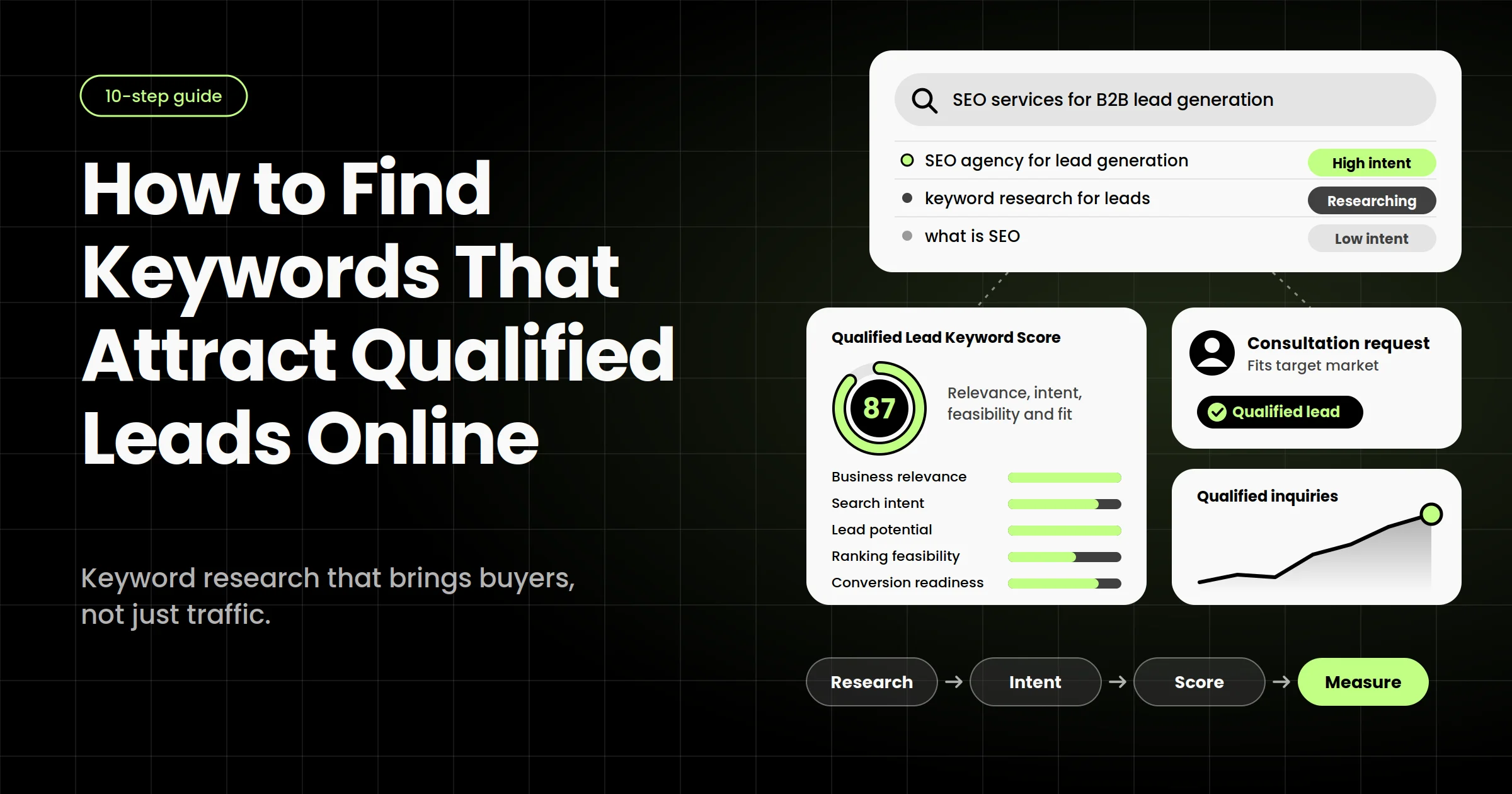
Once you have candidates, a consistent score keeps decisions from drifting toward whichever number looks biggest. The Qualified Lead Keyword Score below is a framework developed for this guide. It is a decision aid, not a validated predictive model, and it does not forecast rankings, conversions, or revenue.
| Criterion | Weight | Question to ask |
| Business relevance | 30% | Does the query relate to a service the business can deliver? |
| Search intent | 25% | Does the query reflect a need the business can satisfy? |
| Lead potential | 20% | Is the audience likely to include suitable prospects? |
| Ranking feasibility | 15% | Is the competitive landscape realistically approachable? |
| Conversion readiness | 10% | Can the website offer a relevant page and clear next step? |
| Total | 100% |
Rate each criterion from 1 to 5, then calculate the weighted score: add up (score ÷ 5 × weight) for all five criteria. Here is a sample keyword that scores 5, 4, 5, 3, and 4.
| Criterion | Score | Calculation | Points |
| Business relevance | 5 | 5 ÷ 5 × 30 | 30 |
| Search intent | 4 | 4 ÷ 5 × 25 | 20 |
| Lead potential | 5 | 5 ÷ 5 × 20 | 20 |
| Ranking feasibility | 3 | 3 ÷ 5 × 15 | 9 |
| Conversion readiness | 4 | 4 ÷ 5 × 10 | 8 |
| Total | 87 / 100 |
Add one rule before scoring: a disqualification check. If the business cannot genuinely serve the searcher, for example because of location or an unoffered service, drop the keyword however well it scores. To use the method, build a spreadsheet with columns for the keyword, intent, the five scores, the weighted score, and the target page. Treat the weights as starting points and adjust them if your own lead data points elsewhere.
Best Keyword Research Tools for Finding Qualified Leads
No single tool can tell you whether a keyword will produce qualified leads. Choose tools by the question you need answered.
| Tool | Best use | Limitation to remember |
| Google Keyword Planner | Discover keyword ideas and estimated advertising demand | Advertising competition is not organic difficulty |
| Google Search Console | Review the queries, clicks, impressions, and click-through rate your site already earns | Search data alone does not show lead quality |
| Ahrefs | Explore keyword ideas, competitor rankings, and organic difficulty estimates | Third-party metrics are estimates |
| Semrush | Research keyword variations, intent labels, and competitor opportunities | Intent labels need review against the live results |
| Google Trends | Compare relative interest over time | Relative interest is not absolute search volume |
Keep two kinds of evidence apart. Keyword Planner and third-party platforms offer estimates about the market. Search Console and analytics offer observed data about your own site. According to Google, Search Console covers what happens before a visitor reaches your site, while Google Analytics covers what visitors do after they arrive (Google Search Central).
Because Keyword Planner is built for advertisers, its cost and competition figures describe paid search. Teams that also invest in PPC services can see which paid search terms produce inquiries. They can then test those themes with organic pages.
Common Keyword Research Mistakes That Reduce Lead Quality
Most of these mistakes come from treating keyword research as a one-time list-building task. Each has a business cost and a practical fix.
| Mistake | Business consequence | Corrective action |
| Choosing keywords mainly by search volume | Traffic from people who cannot or will not buy | Score relevance and intent before volume |
| Assuming long-tail keywords always convert better | Specific pages that attract few or poor-fit visitors | Validate each phrase against the live results and your data |
| Treating advertising competition as organic difficulty | Misjudged ranking effort | Use an organic difficulty estimate and study the ranking pages |
| Ignoring the current search results | The wrong page format for the intent | Review the results before assigning a page type |
| Targeting the wrong audience or location | Inquiries you cannot serve | Apply the disqualification check |
| Publishing several pages for one intent | Pages compete and effort is split | Assign one primary intent per page |
| Using the same call to action everywhere | A mismatch with the visitor’s stage | Match the next step to the intent |
| Counting clicks without checking quality | No way to tell if SEO helps the business | Track qualification and outcomes |
| Treating AI-generated ideas as demand data | Effort spent on phrases few people search | Validate each idea in a keyword tool |
| Promising rankings or conversions | Unmet expectations and lost trust | Present plans as hypotheses to test |
How to Measure Whether Your Keywords Generate Qualified Leads
Measure search results and business outcomes together. Search Console reports impressions, clicks, click-through rate, and queries. Analytics shows what visitors do on your site, including the conversion events you configure. Your CRM records which inquiries were actually qualified. Google notes that Search Console clicks and Analytics sessions are counted differently, so expect the numbers to differ and focus on matching trends.
| Metric | What it tells you |
| Impressions | How often your site appears for relevant searches |
| Clicks | How many visits arrive from organic search |
| Organic conversion rate | How often visitors complete a tracked conversion |
| Qualified-lead rate | What share of inquiries meet your qualification criteria |
| Lead-to-opportunity rate | What share of qualified leads become sales opportunities |
| Lead-to-customer rate | What share of leads become customers, subject to attribution limits |
Define “qualified lead” first. A form submission is a conversion, not automatically a sales opportunity. Attribution is also imperfect. Many customers touch several channels before they inquire, and analytics tools credit those channels differently than Search Console does. Pick one measurement window and use it for every comparison. Review results on a regular schedule rather than expecting a fixed number of weeks. If conversions fall, an SEO audit can help separate technical and on-page problems from keyword-selection problems.
Turn Keyword Research Into a Lead-Generation Strategy
A strong lead generation keyword strategy starts with customers, not tools. Define who you want to reach and collect the words they use. Check intent in the live results and score candidates with one steady method. Give each keyword a fitting page, then measure qualified outcomes. None of this guarantees rankings or leads. It gives you a way to test and improve your choices with evidence.
Putting the process into practice takes working conversion tracking, content that fits each intent, and regular review. If you are planning a professional SEO campaign, treat this process as its first phase, because keyword choices shape the pages, tracking, and reporting that follow. If you want an outside view, request an SEO keyword strategy review from Digital Agency Marketing. Its SEO services team can help you check search intent, service fit, and lead opportunities against your current content.
Frequently Asked Questions
How do you find keywords that generate qualified leads?
Start with customer problems and the language customers use, expand the list with research tools, and check the intent in the live results. Then score candidates for relevance and feasibility, and measure the leads that meet your qualification criteria.
What are high-intent keywords?
They are searches that suggest the person is comparing options or ready to pick a firm, such as “SEO agency for B2B lead generation.” Intent depends on the full query and the results. The same word can mean different things in different industries.
Are long-tail keywords better for lead generation?
Not always. Specific queries often describe a clearer need, which can improve relevance, but they may have little demand. Conversion still depends on the page, the offer, and the audience, so test against your own data.
Which keyword research tools help identify buyer-intent keywords?
Platforms such as Ahrefs and Semrush offer intent-related labels and filters, Keyword Planner supplies ideas and estimates, and Search Console shows the queries you already receive. Confirm any intent label by reading the actual search results.
How do you measure qualified leads from SEO?
Connect Search Console queries and landing pages to conversion events in analytics. Then record in your CRM which inquiries met your criteria and became opportunities. Expect imperfect attribution and compare results over a consistent window.